National Center on Generative AI for Uplifting STEM+C Education (GENIUS Center)
About |
Generative AI for Uplifting STEM+C Education
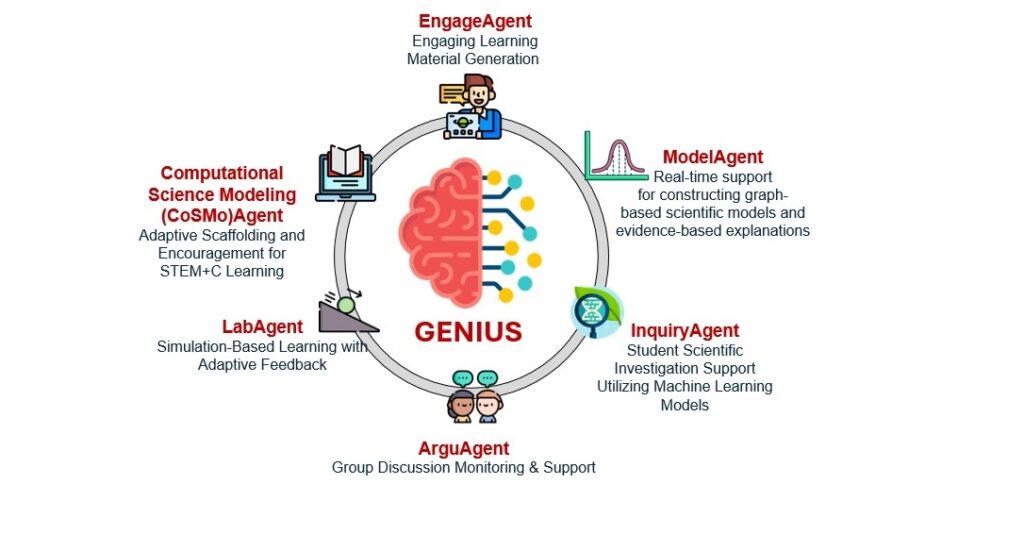
The development of a competent STEM and computing (STEM+C) workforce in the era of generative artificial intelligence (GenAI) is crucial for the nation’s economic growth, security, and global competitiveness. The National GENIUS Center integrates generative AI with the teaching and learning of science and engineering practices through a GenAI learning agent — GenAgent — that serves as a mentor, learning buddy, collaborative learning agent, and teacher assistant to promote six key middle school science and engineering practices (SEPs). The Center conducts exploratory studies examining how GenAI is currently used in classrooms, develops and refines the GenAgent system through a design-based approach, and conducts a pilot study to assess GenAgent’s promise for improving learner outcomes. In addition, the GENIUS Center provides national leadership and outreach on the responsible use of GenAI in education, collaborating with teachers, school districts, academic institutions, entrepreneurs, and policymakers. Research takes place in urban and rural middle schools across five states — Georgia, Michigan, South Carolina, Tennessee, and California — with an anticipated sample of approximately 175 teachers and 15,000 students representing diverse racial, ethnic, and ability backgrounds.
Sponsor: Institute of Education Sciences
Funding: $10,000,000
Timeline: 2024-2029
Our Team
Principal Investigator

Co-Principal Investigator

Co-Principal Investigator
Publications
Journal Articles
Latif, E., Liu, V., & Zhai, X. (2026). A systematic review of intelligent and robot tutoring systems: evolution, pedagogical design, and AI-driven classification. Smart Learning Environments. https://doi.org/10.1186/s40561-025-00427-9
Latif, E., Zhou, Y., Guo, S., Shi, L., Gao, Y., Nyabaa, M., Bewersdorf, A., Tong, X., & Zhai, X. (2026). Comparative Evaluation of OpenAI O1 and Human Performance in Higher Order Cognition. Nature Scientific Reports. https://doi.org/10.1038/s41598-025-33629-9
Bewersdorff, A., Nerdel, C., Zhai, X. (2025). How AI literacy correlates with affective, behavioral, cognitive and contextual variables: A systematic review. Computers & Education: Artificial Intelligence. https://doi.org/10.1016/j.caeai.2025.100493
Fang, L., Yu, X., Cai, J., Chen, Y., Wu, S., Liu, Z., Yang, Z., Lu, H., Gong, X., Liu, Y., Ma, T., Ruan, W., Abbasi, A., Zhang, J., Wang, T., Latif, E., Liu, W., Zhang, W., Kolouri, S., Zhai, X., Zhu, D., Zhong, W., Liu, T., & Ma, P. (2025). Knowledge distillation and dataset distillation of large language models: Emerging trends, challenges, and future directions. Artificial Intelligence Review. 59(17), 1-62. https://doi.org/10.1007/s10462-025-11423-3
Lee, G., Shi, L., Latif, E., Gao, Y., Bewersdorf, A., Nyaaba, M., Guo, S., Liu, Z., Mai, G., Liu, T., & Zhai, X. (2025). Multimodality of AI for Education: Towards Artificial General Intelligence. IEEE Transactions on Learning Technologies. 18, 666-683. https://doi.org/10.1109/TLT.2025.3574466
Gao, Y., Zhai, X., Li, M., & Li, X. (2025). A Multimodal Interactive Framework for Science Assessment in the Era of Generative Artificial Intelligence. Journal of Research in Science Teaching. 1-15. https://doi.org/10.1002/tea.70009
Bewersdorff, A., Hartmann, C., Hornberger, M., Seßler, K., Bannert, M., Kasneci, E., Kasneci, G., Zhai, X., Nerdel, C. (2025). Taking the Next Step with Generative Artificial Intelligence: The Transformative Role of Multimodal Large Language Models in Science Education. Learning and Individual Differences. 118, 102601, 1-13. https://doi.org/10.1016/j.lindif.2024.102601
Lee, G. & Zhai, X. (2025). Realizing Visual Question Answering for Education: GPT-4V as a Multimodal AI. TechTrends. 69, 271–287. https://doi.org/10.1007/s11528-024-01035-z
Zhai, X. (2024). Transforming Teachers’ Roles and Agencies in the Era of Generative AI: Perceptions, Acceptance, Knowledge, and Practices. Journal of Science Education and Technology. 1-11. https://doi.org/10.1007/s10956-024-10174-0
Tian, J., Sobczak, M., Patil, D., Hou, J., Pang, L., Ramanathan, A., Yang, L., Chen, X., Golan, Y., Zhai, X., Sun, H., Song, K., Wang, X. (2025). CrossMatAgent: AI-Assisted Design of Manufacturable Metamaterial Patterns via Multi-Agent Generative Framework. Advanced Intelligent Discovery. 202500063. 1-25. https://doi.org/10.1002/aidi.202500063
Watts, F. M., Liu, L., Ober, T. M., Song, Y., Jusino del Valle, E. N., Wang, Y., Liu, N., Zhai, X. (2025). A framework for designing an AI chatbot to support scientific argumentation. Education Sciences. 15(11), 1507. https://www.mdpi.com/2227-7102/15/11/1507
Book Chapters
Zhai, X., Pellegrino, J. W., Rojas, M., Park, J., Nyaaba, M., Cohn, C., & Biswas, G. (in press). Science literacy: Generative AI as enabler of coherence in the teaching, learning, and assessment of scientific knowledge and reasoning. In The handbook of generative AI in education: Implications for research and practice. Springer.
Zhai, X. (in press). Generative AI User Experience: Developing Human–AI Epistemic Partnership. In X. Zhai, E. Latif & G. Biswas (Eds.), Teaching and Learning in the Era of Generative AI. Springer.
Zhai, X. (in press). From Tools to Epistemic Partners: Rethinking Education in the Age of Generative AI. In X. Zhai, E. Latif & G. Biswas (Eds.), Teaching and Learning in the Era of Generative AI. Springer.
Jiao, H., Choi, H., Fang, L., Zhai, X. (in press). Data Augmentation in Computational Psychometrics. In A. Davier & D. Yan (Eds.), Artificial Intelligence in Educational Learning and Assessment.
Conference Proceedings
Bewersdorff, A., Yuruk, N., & Zhai, X. (2026). The simulation of validity: Modal decoupling in MLLM-generated feedback on science drawings. 27th International Conference on Artificial Intelligence in Education (AIED 2026).
Huang, S., Zhai, X., Zou, Y., & Gao, C. (2026). AI–human collaboration: How AI-powered teaching agent transforms classroom learning. International Conference on Artificial Intelligence in Education (AIED 2026).
Kleiman, J., Gao, Y., Xia, X., Wang, Z., Zhu, Z., Park, J., & Zhai, X. (2026). ArguAgent: Designing for productive disagreement in collaborative STEM argumentation. International Conference on Artificial Intelligence in Education (AIED 2026).
Watts, F. M., Liu, L., Ober, T. M., Song, Y., Jusino-Del Valle, E., Wang, Y., & Zhai, X. (2026). AI evaluation and feedback to support middle-school students’ scientific argumentation and reasoning. International Conference on Artificial Intelligence in Education (AIED 2026).
Xia, X., Yuruk, N., Wang, Y., & Zhai, X. (2026). Are task-specific human rubrics necessary for AI-generated feedback? Comparing learning-progression-driven and expert-rubric-driven AI feedback. International Conference on Artificial Intelligence in Education (AIED 2026).
Zhang, Y., Gao, Y., Cheng, N., Yuan, G., Young, N., Li, H., & Zhai, X. (2026). From items to misconceptions: Using LLMs to refine Q-matrix labeling with confidence tiers. International Conference on Artificial Intelligence in Education (AIED 2026).
Zhu, Q., Zhai, X., Zou, Y., & Gao, C. (2026). Using AI-generated feedback to improve critical thinking and writing proficiency. International Conference on Artificial Intelligence in Education (AIED 2026).
Zou, J., Zhai, X., & Gao, C. (2026). Beyond information retrieval: Generative AI as an epistemic arbiter for enhancing collaborative problem-solving. International Conference on Artificial Intelligence in Education (AIED 2026).
Fang, L., Wang, T., Ma, P., & Zhai, X. (2026). Generalizable and Efficient Automated Scoring with a Knowledge-Distilled Multi-Task Mixture-of-Experts. AAAI & EAAI.
Wang, Y., Ding, Z., Wu, X., Sun, S., Liu, N., & Zhai, X. (2026). AutoSCORE: Enhancing Automated Scoring with Multi-Agent Large Language Models via Structured Component Recognition. AAAI & EAAI.
Latif, E., Zirak, K., & Zhai, X. (2025). SketchMind: A Multi-Agent Cognitive Framework for Assessing Student-Drawn Scientific Sketches. Proceedings of NeurIPS Conference.
Latif, E., Liu, N., Biswas, G., Yin, Y., & Zhai, X. (2025). Workshop on Epistemics and Decision-Making in AI-Supported Education. Artificial Intelligence in Education. AIED 2025. Communications in Computer and Information Science, vol 2592. Springer. https://doi.org/10.1007/978-3-031-99267-4_27
Fang, L., Latif, E., Lu, H., Zhou, Y., Ma, P., & Zhai, X. (2025). Efficient Multi-task Inferencing: Model Merging with Gromov-Wasserstein Feature Alignment. Artificial Intelligence in Education. AIED 2025. Communications in Computer and Information Science, vol 2592. Springer. https://doi.org/10.1007/978-3-031-99267-4_24
Guo, S., Wang, Y., Yu, J., Wu, X., Ayik, B., Watts, F., Latif, E., Liu, L., Liu, N., & Zhai, X. (2025). Artificial Intelligence Bias on English Language Learners in Automatic Scoring. Artificial Intelligence in Education. AIED 2025. Lecture Notes in Computer Science, vol 15881. Springer. https://doi.org/10.1007/978-3-031-98462-4_34
Zhang, L., Zhai, X., Lin, J., Kleiman, J., Forsyth, C. D., Jiang, Y., Hu, X., & Graesser, A. (2025). Exploring Communication Strategies for Collaborative LLM Agents in Mathematical Problem-Solving. Artificial Intelligence in Education. AIED 2025.Communications in Computer and Information Science, vol 2591. Springer. https://doi.org/10.1007/978-3-031-99264-3_32
Latif, E. & Zhai, X. (2025). Privacy-Preserved Automated Scoring Using Federated Learning for Educational Research. Artificial Intelligence in Education. AIED 2025.Communications in Computer and Information Science, vol 2592. Springer. https://doi.org/10.1007/978-3-031-99267-4_17
Visit the GENIUS Website!