
A remarkable thread connects three recent volumes co edited by Xiaoming Zhai and his collaborators: a commitment to understanding how artificial intelligence can transform STEM learning and how it can be implemented responsibly, ethically, and in ways that empower both educators and students.
Uses of Artificial Intelligence in STEM Education (edited by Xiaoming Zhai and Joseph Krajcik) provides a broad foundation for the field, examining how AI, machine learning, and large language models are reshaping assessment, instruction, teacher professional development, and learning supports across STEM disciplines. The volume highlights emerging applications such as automated assessment, intelligent tutoring systems, adaptive learning environments, and tools that support diverse learners while emphasizing the importance of ethics, fairness, and inclusivity.
Building on this foundation, Artificial Intelligence for STEM Education Research: Advanced Methods and Applications (edited by Xiaoming Zhai and Gyeonggeon Lee) shifts the focus from classroom implementation to research innovation. The volume demonstrates how AI can serve as a powerful methodological tool for STEM education researchers through applications such as automatic scoring, explainable AI, adaptive learning systems, and intelligent tutoring technologies. By presenting practical examples and advanced research methods, the book offers new pathways for rigorous, data-driven inquiry in STEM education.
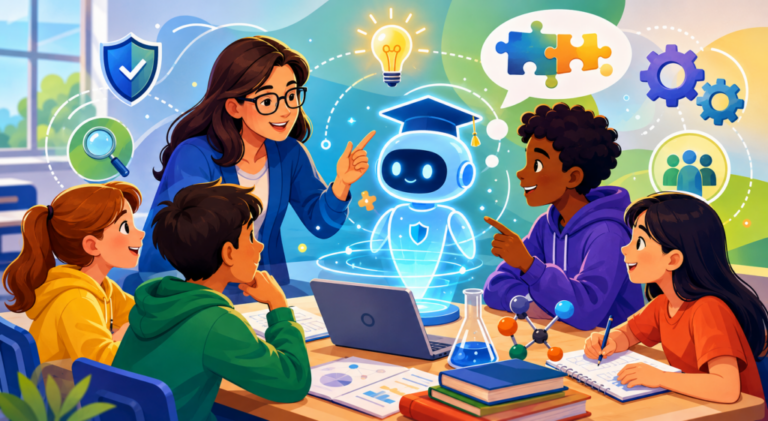
The newest volume, Advancing AI in Science Education: Envisioning Responsible and Ethical Practice (edited by Xiaoming Zhai and Kent J. Crippen), extends this work by addressing one of the field’s most pressing questions: how can AI be integrated into science education while preserving equity, transparency, human judgment, and democratic participation? The book introduces the Responsible and Ethical Principles (REP) framework, offering guidance for designing, using, and governing AI in ways that support scientific integrity, meaningful learning, and human-centered educational practices.
Taken together, these three volumes chart an important evolution in the field. The first explores what AI can do in STEM education; the second examines how AI can advance STEM education research; and the third considers how AI should be used responsibly in science education. Collectively, they provide educators, researchers, and policymakers with a comprehensive roadmap for harnessing AI’s potential while ensuring that innovation remainsgrounded in equity, ethics, and the human dimensions of learning.
References:
Zhai, X., & Crippen, K. J. (Eds.). (2026). Advancing AI in science education: Envisioning
responsible and ethical practice (Vol. 3). Springer. https://doi.org/10.1007/978-3-032-16871-9
Zhai, X., & Krajcik, J. (Eds.). (2024). Uses of artificial intelligence in STEM education.
Oxford University Press. https://doi.org/10.1093/oso/9780198882077.001.0001
Zhai, X., & Lee, G. (Eds.). (2026). Artificial intelligence for STEM education research:
Advanced methods and applications (Vol. 1). Springer. https://doi.org/10.1007/978-3-032-06565-0